How to Compare Unit Prices When Shopping Online
The bigger pack is not always the cheaper one, and the pack with the lower sticker price is often the worse deal. Online listings make it harder, because the same product can be sold in grams, ounces, millilitres and “packs of six” on different pages. The fix is to compare the price of one standard unit.
The idea in one line
Unit price = price ÷ quantity, with the quantity written in the unit you want to compare: per kilogram, per 100 grams, per litre or per piece.
A simple example
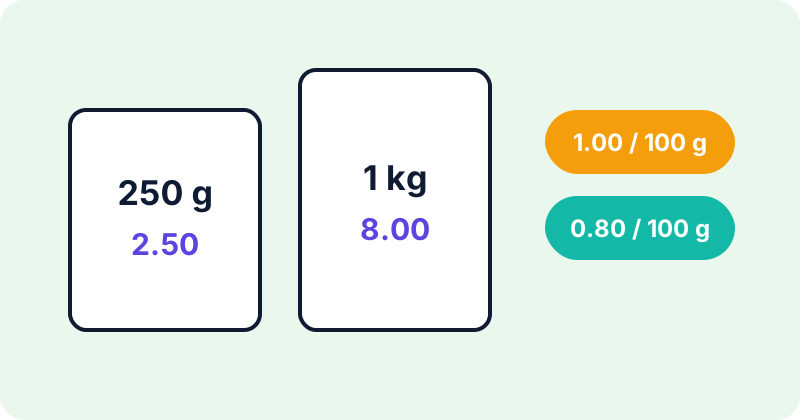
A 250 g pack costs 2.50. A 1 kg pack costs 8.00. The small pack costs 2.50 ÷ 250 × 100 = 1.00 per 100 g. The large pack costs 8.00 ÷ 1000 × 100 = 0.80 per 100 g. Per kilogram, that is 10.00 against 8.00, so the large pack is 20% cheaper per kilogram. It is a better deal only if you will use it all.
Multipacks
For multipacks, multiply first. A pack of six 330 ml cans for 3.60 holds 6 × 330 = 1,980 ml, which is 1.98 litres. The price per litre is 3.60 ÷ 1.98 = 1.82. A 1.5 litre bottle at 1.80 costs 1.80 ÷ 1.5 = 1.20 per litre, which is cheaper, though the cans may be more convenient.
Converting units
| Unit | Equals |
|---|---|
| 1 kg | 1,000 g |
| 1 lb | 453.592 g |
| 1 oz | 28.3495 g |
| 1 litre | 1,000 ml |
| 1 US fluid ounce | 29.5735 ml |
Sixteen ounces is about 453.6 g, so a 16 oz pack for 3.00 costs about 6.61 per kilogram. Weight and volume cannot be converted to each other without knowing the product, so do not compare a bottle of oil in litres with a block of butter in grams.
Step by step with the tool
- Open the Unit Price Comparison Calculator.
- For each product, enter the price, the quantity in the pack and the unit.
- For a multipack, enter the total quantity, such as 1,980 ml.
- Read the price per unit and which item is cheapest.
Traps to watch for
- Different units on different listings. Convert before you compare.
- Delivery fees. A cheaper product with a delivery charge may cost more overall. Add the fee to the price, or compare the delivery-inclusive total.
- Minimum spend for free delivery. Do not buy extra items you do not need just to reach it.
- Subscription discounts. A lower unit price may require a repeat order. Check the conditions and how to cancel.
- Changed pack sizes. Manufacturers sometimes change the quantity in a pack while the look stays the same, so recheck the unit price of products you buy regularly.
- Stacked offers. If you have a coupon on top of a sale, work out the price after both with the Stacked Discount and Coupon Calculator before comparing.
When the cheapest unit price is not the best choice
Unit price ignores whether you will use everything. Food that spoils, products with a short expiry date, and items you will not finish can turn a bargain into waste. Quality, brand, ingredients and storage space also matter, and the unit price says nothing about them.
Household items and other non-food products
Unit prices are not only for food. Paper products, batteries, cleaning refills and cosmetics are all sold in sizes designed to look similar. Take two paper-towel offers: 12 rolls of 200 sheets for 9.60, and 6 rolls of 300 sheets for 6.30. The first gives 2,400 sheets and the second 1,800. Per 100 sheets, the first costs 9.60 ÷ 24 = 0.40 and the second 6.30 ÷ 18 = 0.35, so the second is cheaper per sheet even though it has fewer rolls.
When a single unit is tiny, such as one sheet or one capsule, the price per piece is a very small number. In the calculator, enter the quantity in hundreds (24 for 2,400 sheets) so the answer reads as a price per hundred.
Compare prices on the same basis
Some shops show prices with tax and others without. Before you compare, make sure both prices include or both exclude tax. If you only have one version, the VAT, GST and Sales Tax Calculator can add or remove tax at a rate you enter. Do the same with delivery fees: either include them in both prices or in neither.
A short checklist before you buy
- Is the quantity written in the same unit on every listing?
- Have I multiplied out multipacks?
- Do both prices include tax and delivery, or neither?
- Will I use the whole product before it expires or goes stale?
- Is there a coupon or sale price that changes the comparison?
Conclusion
Convert everything to one unit, multiply out multipacks, add delivery, and only then compare. The few minutes it takes can save real money on things you buy often.
Try the tools
Frequently asked questions
Is a bigger pack always cheaper per unit?
No. Sometimes the smaller pack, or a pack on offer, has the lower unit price.
How do I compare a multipack?
Multiply the quantity of each item by the number in the pack, then divide the price by the total.
Should I include delivery in the comparison?
Yes, if you pay for it, because it changes the real price.
Can I compare weight with volume?
No, not without knowing the product’s density.