Profit Margin vs Markup: What Is the Difference?
If you sell online, two percentages decide whether your shop makes money: margin and markup. They sound alike, they use the same numbers, and they are constantly mixed up. The mix-up is expensive, because a price built on the wrong one can leave you with less profit than you planned.
The two definitions
Markup is profit as a percentage of what the item cost you. Margin is profit as a percentage of the price you sell it for.
- Profit = selling price − cost
- Markup = profit ÷ cost × 100
- Margin = profit ÷ selling price × 100
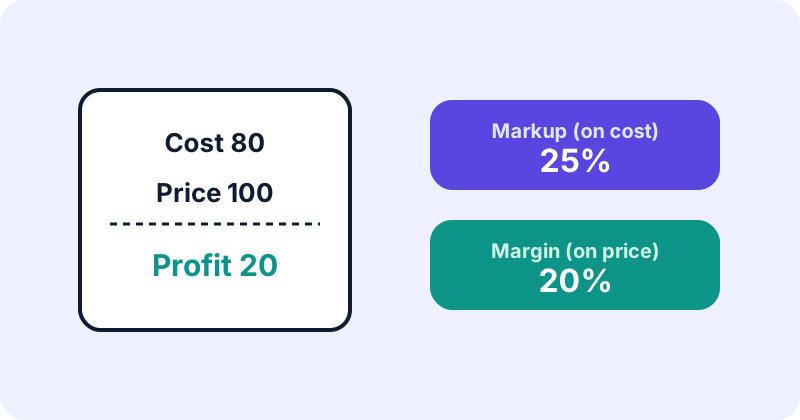
Take an item that costs 80 and sells for 100. The profit is 20. The markup is 20 ÷ 80 = 25%. The margin is 20 ÷ 100 = 20%. Same sale, two correct but different percentages. Margin is always the smaller of the two, because the selling price is bigger than the cost.
Converting between them
You can convert one into the other with simple formulas: margin = markup ÷ (1 + markup), and markup = margin ÷ (1 − margin), with the percentages written as decimals.
| Markup | Margin |
|---|---|
| 25% | 20% |
| 50% | 33.33% |
| 100% | 50% |
| Margin | Markup |
|---|---|
| 20% | 25% |
| 30% | 42.86% |
| 40% | 66.67% |
| 50% | 100% |
A 100% markup means you sell at double the cost, and that is only a 50% margin. A margin of 100% is impossible, because it would mean the item cost nothing.
Why the difference matters when you set a price
Say your cost is 70 and you want a 30% margin. Many people add 30% to the cost: 70 × 1.30 = 91. But at a price of 91, the profit is 21, and 21 ÷ 91 = 23.08%, not 30%. To get a 30% margin the price must be cost ÷ (1 − 0.30) = 70 ÷ 0.70 = 100. The difference of 9 on every sale adds up quickly.
Gross margin is not what you keep
The margin above is a gross figure, based only on the item’s cost. Online sellers also pay platform commission, payment fees, shipping, packaging, advertising and sometimes returns. Suppose the item costs 50 and sells for 100. The gross margin looks like 50%. But if you also pay 14 in fees, 5 for shipping, 2 for packaging and 4 for advertising, your net profit is 25, and the net margin is 25%. The Marketplace Fee and Net Profit Calculator does this sum for you, and it also finds the break-even price.
How to price a product, step by step
- Add up every cost you pay for one sale: the item, shipping, packaging, fixed fees and advertising.
- Decide your fee percentages from your platform and payment account.
- Choose the margin you want on the selling price.
- Price = fixed costs ÷ (1 − fee percentages − wanted margin), with percentages as decimals.
- Check the result against competitors and adjust, then recalculate the margin at the new price.
The Profit Margin and Markup Calculator handles the first two cases directly: it shows margin and markup from a cost and price, and the price for a margin or markup you choose.
Common mistakes
- Using a markup percentage as if it were a margin, or the other way round.
- Ignoring fees, shipping and advertising when calculating profit.
- Forgetting that discounts reduce the margin. A 20% discount on a price with a 30% margin does not leave a 10% margin. At a price of 100 and a cost of 70, a 20% discount gives a price of 80 and a profit of 10, which is a 12.5% margin.
- Rounding too early and comparing figures that were rounded differently.
Limits
These formulas describe arithmetic only. A good margin depends on your costs, competition and how many items you sell, and no number here can tell you what to charge. Taxes and accounting rules also differ by country, so check them with a qualified professional.
What happens to margin when you discount
A discount comes straight out of your profit, so it shrinks margin faster than most people expect. With a cost of 70 and a price of 100, the margin is 30%. Look at what each discount does:
| Discount | New price | Profit | Margin |
|---|---|---|---|
| 0% | 100 | 30 | 30% |
| 10% | 90 | 20 | 22.22% |
| 20% | 80 | 10 | 12.5% |
| 30% | 70 | 0 | 0% |
A 30% discount on a 30% margin leaves nothing at all. Before you run a sale, work out the new margin, and remember to count fees and shipping too. Our guide to calculating discounts and final prices shows how the percentages combine.
Covering fixed costs
Margin is per item, but a business has costs that do not change with each sale, such as software, storage or a website. If these come to 1,000 a month and each sale earns 20 in profit, you need 1,000 ÷ 20 = 50 sales just to break even. A thinner margin means more sales are needed for the same result, which is why it is worth checking both numbers together.
Saying which one you mean
When you talk to suppliers, partners or an accountant, say “markup on cost” or “margin on price” explicitly. The same number means very different things depending on the base, and many misunderstandings come from assuming everyone uses the same one.
Conclusion
Markup looks at cost; margin looks at price. Decide which one you are talking about, price for the margin you need, and count every cost before you call a sale profitable.
Try the tools
Frequently asked questions
Which is bigger, margin or markup?
Markup is always bigger, because it divides the same profit by the smaller number, the cost.
What markup gives a 50% margin?
A 100% markup. The price is double the cost.
Is a high margin always better?
Not necessarily. A high margin on few sales can earn less than a modest margin on many.
Do I include shipping in the cost?
If you pay for it, yes, for a realistic profit figure.