How Volumetric Weight Affects Your Shipping Costs
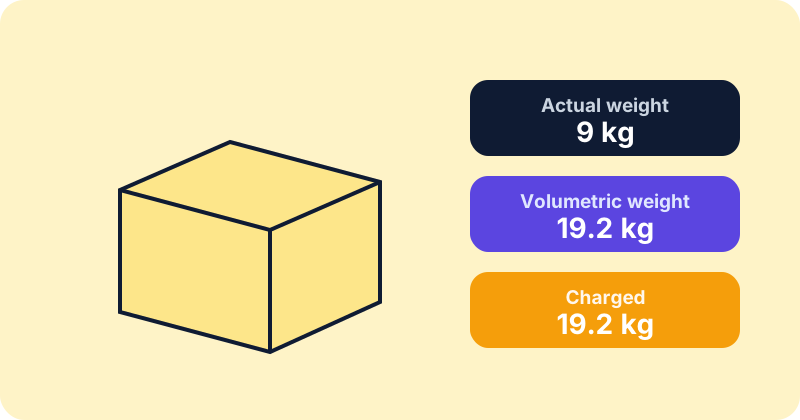
You weigh a parcel at 9 kg, check the courier’s rate for 9 kg, and are then charged for 19. Nothing went wrong. The courier charged for the space your parcel takes up, not only for its weight. This is called volumetric or dimensional weight, and it catches many new online sellers by surprise.
Why couriers do it
Vehicles and aircraft fill up with space as well as with weight. A big box of pillows can fill as much room as a small box of metal parts that weighs ten times more. To charge fairly for the room used, many carriers calculate a volumetric weight and bill whichever is higher: the actual weight or the volumetric weight. That higher figure is the chargeable weight.
The calculation
Volumetric weight = length × width × height ÷ divisor.
The divisor is set by the carrier. Commonly seen values include 5000 or 6000 cubic centimetres per kilogram, and 139 or 166 cubic inches per pound, but you must use the one in your carrier’s terms. Measure the packed parcel, including the packaging, at its widest points.
Worked examples
- A 60 × 40 × 40 cm box is 96,000 cubic cm. Divided by 5000, its volumetric weight is 19.2 kg. If it weighs 9 kg, you pay for 19.2 kg.
- The same product in a 50 × 35 × 30 cm box is 52,500 cubic cm, which is 10.5 kg at the same divisor. The chargeable weight falls from 19.2 kg to 10.5 kg, by 45%, just by choosing a tighter box.
- A dense parcel of 20 × 20 × 10 cm and 2 kg has a volumetric weight of 0.8 kg, so you pay for its actual 2 kg.
How to reduce your chargeable weight
- Use the smallest box that protects the goods. Even a few centimetres off one side can matter.
- Remove empty space and excess padding, but never at the cost of damage in transit.
- Use flexible polybags for soft items such as clothing, if the product allows.
- Flat-pack or fold products where possible.
- Standardise a few box sizes that fit your products well, so you do not use an oversized box by habit.
- Ask your carrier how it rounds. Some round each dimension or the final weight up, which can change the price.
Using the calculator
Open the Volumetric Weight Calculator, choose metric or imperial, enter the length, width, height and actual weight, and set the divisor to your carrier’s value. It shows the volumetric weight and the chargeable weight, and tells you whether the parcel is charged on size or on weight. It does not know prices, so take the chargeable weight to your carrier’s rate card.
Build shipping into your profit calculation
Shipping cost is part of what each sale really earns you. If you offer free shipping, you pay it from your margin. Enter your real shipping cost in the Marketplace Fee and Net Profit Calculator to see whether a sale is still worth making, and read our guide to margin and markup to price accordingly.
Limits and common mistakes
- Using the wrong divisor. There is no universal one.
- Measuring the product instead of the packed parcel.
- Forgetting surcharges for very long, heavy or irregular parcels, which are charged separately by many carriers.
- Assuming domestic and international services use the same rules.
How padding changes the numbers
Protective packaging adds thickness on every side, and that adds up in all three dimensions. A product measuring 40 × 30 × 20 cm has a volume of 24,000 cubic cm, which is 4.8 kg of volumetric weight at a divisor of 5000. With 3 cm of padding on every side, the box becomes 46 × 36 × 26 cm, which is 43,056 cubic cm, or 8.61 kg. That is nearly double the volumetric weight, and it shows why tight, well-chosen packaging matters more than it first appears.
The divisor changes the answer too
The same parcel can be charged differently by different carriers. A box of 60,000 cubic cm has a volumetric weight of 15 kg at a divisor of 4000, 12 kg at 5000 and 10 kg at 6000. Always use the divisor stated by the carrier you will actually ship with, and compare carriers on the chargeable weight rather than the sticker rate per kilogram.
A checklist before you ship
- Measure the packed parcel at its longest, widest and tallest points.
- Weigh it on a scale that you trust.
- Calculate the volumetric weight with your carrier’s divisor.
- Compare it with the actual weight and note which is higher.
- Look for a smaller box if the volumetric weight is much higher than the actual weight.
- Check for oversize or handling surcharges in the carrier’s terms.
Conclusion
Know your carrier’s divisor, measure the packed parcel, and compare actual and volumetric weight before you set shipping prices. A better-fitting box is often the easiest saving a seller can make.
Try the tools
Frequently asked questions
What divisor do couriers use?
It varies by carrier and service. Check the terms of yours.
Is volumetric weight the same as dimensional weight?
Yes. The two names mean the same thing.
Do I always pay the volumetric weight?
No. You pay the higher of the actual weight and the volumetric weight.
Does it apply to small light parcels?
Rarely changes the price for dense, small parcels, but check your carrier’s rules.