How to Calculate Discounts and Final Prices
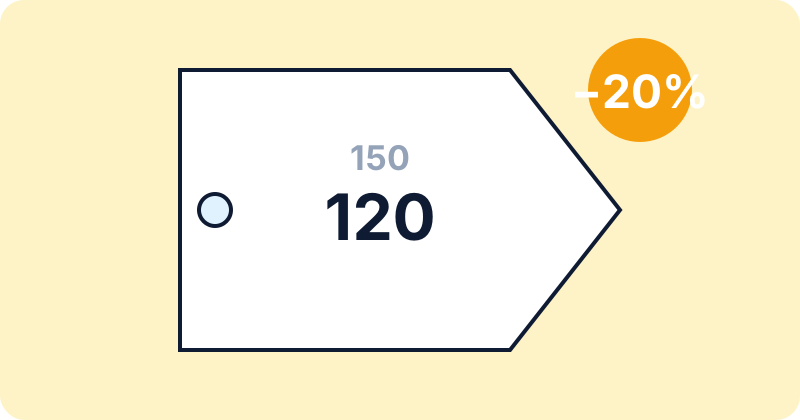
A sign says 30% off. What will you actually pay? The calculation is short once you see the pattern, and knowing it helps you compare offers that look different.
The basic formula
Discount amount = original price × discount % ÷ 100
Final price = original price − discount amount
Example: a 150 item at 20% off. Discount = 150 × 20 ÷ 100 = 30. Final price = 150 − 30 = 120.
The multiplier shortcut
Instead of subtracting, multiply by (100 − discount) ÷ 100. For 20% off, multiply by 0.8: 150 × 0.8 = 120. For 35% off, multiply by 0.65.
Adding tax
Many places add tax after the discount. With a price of 80, 25% off and 10% tax: discount = 20, discounted price = 60, tax = 60 × 10 ÷ 100 = 6, final price = 66. Some regions show prices with tax already included, so read the label.
Stacked discounts
Two discounts do not simply add. Take 20% off, then another 10% off: 100 becomes 80, then 72. The total saving is 28, not 30. Each discount applies to the price left after the previous one.
Finding the original price
If you know the final price and the discount, divide: original = final ÷ (1 − discount ÷ 100). A 120 price after 20% off means the original was 120 ÷ 0.8 = 150.
Percentage change and percentage points
Going from 80 to 100 is a 25% increase, but going from 100 back to 80 is a 20% decrease, because the starting numbers differ. Also remember that a change from 10% to 12% is two percentage points, which is a 20% relative increase.
Using the tool
- Open the Percentage and Discount Calculator.
- In the discount box, enter the price, the discount % and optionally a tax %.
- Read the final price and the working shown underneath.
Common mistakes
- Adding stacked discounts together.
- Applying tax to the original price when it is charged after the discount.
- Rounding too early, then multiplying.
- Comparing “40% off” on different original prices without checking the final price.
A note on advice
These are general calculations. Shops differ in rounding and tax rules, so the receipt is the final authority. This is not financial or tax advice.
Reading real sale signs
“Up to 50% off” means the best discount is 50%, but many items may be reduced by less. “From 20%” means 20% is the smallest cut. “Extra 10% off already reduced prices” usually means a second discount applied after the first, which is the stacked case described above. Find the price per item and calculate the final price instead of relying on the headline percentage.
Percent off versus amount off
A discount can be stated as a percentage or as a fixed amount, and converting between them helps you compare. A 25% discount on an 80 item saves 20. A 15 reduction on the same item is 15 ÷ 80 = 18.75%, which is a smaller discount than 25%. Dividing the saving by the original price always gives you the percentage.
Comparing two offers
Which is cheaper: 30% off an item priced 90, or 25% off an item priced 80? The first costs 90 × 0.70 = 63. The second costs 80 × 0.75 = 60. The smaller percentage wins here because the starting price was lower. Always compare the final prices when the starting prices differ.
Unit prices
When sizes differ, compare cost per unit. A 500 g pack at 4.50 costs 9.00 per kilogram (4.50 ÷ 0.5). A 750 g pack at 6.00 costs 8.00 per kilogram (6.00 ÷ 0.75). The larger pack is cheaper per kilogram, though only worth it if you will use all of it.
Working backwards from a price with tax
If a price already includes 10% tax and the total is 66, the price before tax is 66 ÷ 1.10 = 60, and the tax is 6. Divide by one plus the rate, not by subtracting the rate from the total. The same idea finds a pre-discount price from a sale price, as in the original price example earlier.
Markup and margin are different
Sellers sometimes mix up two percentages. If an item costs 80 and is sold at 100, the markup on cost is 25% (20 ÷ 80), but the margin on the selling price is 20% (20 ÷ 100). Using the wrong one changes the price you calculate. This is general arithmetic, not business advice.
Rounding and receipts
Shops may round each item separately or only the total, and tax may be calculated per line or on the whole basket. This can create a difference of a few cents or paise between your calculation and the receipt. The calculator on this site rounds only for display, which keeps its own working accurate.
Conclusion
Multiply by what remains after the discount, add tax last if that is how it is charged, and compare final prices rather than percentages.
Try the tools
Frequently asked questions
How do I calculate 25% off quickly?
Multiply by 0.75.
Do two 10% discounts equal 20%?
No. They equal 19%, because 100 becomes 90 and then 81.
Is tax added before or after the discount?
It depends on the shop and region. Check the receipt.
How do I find the original price?
Divide the final price by one minus the discount rate.