Volumetric (dimensional) weight calculator for shipping
Find out whether a parcel will be charged on its size or its weight, using your carrier’s divisor.
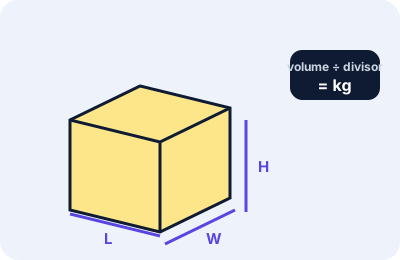
Enter sizes in cm and weight in kg. The divisor is in cubic cm per kg.
Why couriers charge on size
A large, light box takes up as much space on a plane or van as a heavy one. Many couriers therefore compare the parcel’s real weight with its volumetric weight (also called dimensional weight) and charge for whichever is higher. This is the chargeable weight.
The formula
Volumetric weight = length × width × height ÷ divisor. The divisor is set by the carrier. Commonly seen values are 5000 or 6000 cubic centimetres per kilogram, and 139 or 166 cubic inches per pound, but your carrier decides, so check its terms before relying on a figure.
How to use this tool
- Choose metric or imperial. The divisor switches to a common starting value, 5000 or 139.
- Enter the length, width and height of the packed parcel, outer dimensions including the packaging.
- Enter the actual weight, then change the divisor to match your carrier if it differs.
- Read the volumetric weight and the chargeable weight.
Worked examples
- 50 × 40 × 30 cm is 60,000 cubic cm. Divided by 5000, the volumetric weight is 12 kg. If the parcel weighs 8 kg, it is charged as 12 kg.
- 20 × 16 × 12 inches is 3,840 cubic inches. Divided by 139, the volumetric weight is 27.63 lb. A 15 lb parcel is charged as 27.63 lb.
- A 20 × 20 × 10 cm parcel (4,000 cubic cm) has a volumetric weight of 0.8 kg at 5000, so a 2 kg parcel is charged on its real weight.
Saving money
Use the smallest box that protects the goods, remove empty space, and avoid oversized outer packaging. Reducing one side by a few centimetres can lower the chargeable weight noticeably.
Limits
- Carriers usually round up to the next whole unit or half unit and may add surcharges for size. This tool does not round, so ask your carrier how it rounds.
- It does not know prices. It only calculates weights.
- Measure the parcel at its widest points, because bulging boxes count.
Troubleshooting
| What you see | Likely reason | What to try |
|---|---|---|
| “Enter the length, width and height” | A size box is empty | Fill in all three |
| My carrier’s figure is higher | Different divisor or rounding | Enter your carrier’s divisor and round as it does |
| Divisor looks wrong after switching system | Switching resets it to a common value | Type your carrier’s value |
Notice
This is a general-purpose calculator for information only. It is not financial, tax, accounting, customs or legal advice. Rates, fees and rules differ between sellers, platforms, carriers and countries, and the figure on a real invoice or carrier quote is what counts.
Practical scenarios
- A different divisor. A 60 × 40 × 25 cm parcel has a volume of 60,000 cubic cm. It is 15 kg at a divisor of 4000, 12 kg at 5000 and 10 kg at 6000. Enter your carrier’s divisor, not a default.
- A cube-shaped parcel. A 30 × 30 × 30 cm box is 27,000 cubic cm, or 5.4 kg at 5000. If the contents weigh 3 kg, you pay for 5.4 kg.
- The effect of padding. A 40 × 30 × 20 cm product is 4.8 kg of volumetric weight. With 3 cm of padding all round the box is 46 × 36 × 26 cm, or 8.61 kg.
Where to find the divisor
It is usually in the carrier’s terms and conditions, rate card, or help pages, sometimes under the name “dimensional factor” or “volumetric divisor”. If you cannot find it, ask the carrier’s support team. Different services from the same carrier can use different divisors.
Reducing your chargeable weight
- Choose boxes that fit the product closely.
- Use soft packaging for items that can be compressed.
- Ship items in separate parcels only if the total chargeable weight is lower.
More ideas are in our guide to volumetric weight and shipping costs.
Choosing a box: a worked comparison
A product measures 30 × 25 × 20 cm and weighs 3 kg. At a divisor of 5000, three box choices are charged like this.
| Box (cm) | Volume (cubic cm) | Volumetric weight | Charged weight |
|---|---|---|---|
| 30 × 25 × 20 (a perfect fit, rarely possible) | 15,000 | 3.00 kg | 3.00 kg |
| 35 × 28 × 22 | 21,560 | 4.31 kg | 4.31 kg |
| 40 × 30 × 25 | 30,000 | 6.00 kg | 6.00 kg |
The roomier box is charged for 6.00 kg, almost 40% more than the snug 4.31 kg box, for the very same product.
Frequently asked questions
What divisor should I use?
The one your carrier states. 5000 and 139 are only common starting points.
What is chargeable weight?
The higher of the actual weight and the volumetric weight.
Does the tool round up?
No. Ask your carrier how it rounds.