Compare unit prices and find the cheaper pack
Find out which pack is really cheaper by comparing the price per kilogram, litre or piece.
Why unit prices matter
The bigger pack is not always the better deal, and a “family size” can cost more per gram than two small packs on offer. The only fair comparison is the price for one standard unit: per kilogram, per litre or per piece.
How to use this tool
- Fill in one row for each product: its price, the quantity in the pack, and the unit.
- Rows are compared with the first row you fill in. Weights are compared per kilogram, volumes per litre and counted items per piece.
- The cheapest item is marked, and the others show how much more per unit they cost than the cheapest.
Conversions used
| Unit | Equals |
|---|---|
| 1 kg | 1,000 g |
| 1 oz | 28.3495 g |
| 1 lb | 453.592 g |
| 1 litre | 1,000 ml |
| 1 US fl oz | 29.5735 ml |
Worked examples
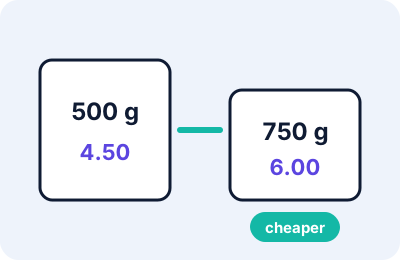
- Pack A: 500 g for 4.50 is 4.50 ÷ 0.5 kg = 9.00 per kg.
- Pack B: 750 g for 6.00 is 6.00 ÷ 0.75 kg = 8.00 per kg. Pack A costs 12.5% more per kg than Pack B, because 9.00 ÷ 8.00 = 1.125.
- Mixed units: 16 oz is 453.59 g, so 3.00 for 16 oz is about 6.61 per kg, which beats both packs above.
Limits
- Weight, volume and counted items cannot be compared with each other. Rows of a different type from the first row are flagged, not converted. The tool does not convert weight to volume, because that depends on the product.
- Fluid ounces are US fluid ounces. UK fluid ounces are slightly different.
- A lower unit price is only a better deal if you will use all of the product before it spoils.
- Shipping, delivery fees and discounts are not included unless you add them to the price.
Troubleshooting
| What you see | Likely reason | What to try |
|---|---|---|
| “Different type of unit” | You mixed weight with volume or pieces | Compare like with like |
| “Enter a price and a quantity” | A box is empty or zero | Fill in both |
| “Add another item to compare” | Only one row is valid | Fill in a second row |
Notice
This is a general-purpose calculator for information only. It is not financial, tax, accounting or legal advice. Prices, rates, fees and rules differ between sellers, platforms and countries.
Practical scenarios
- Multipacks. Six cans of 330 ml for 3.60 hold 1,980 ml. Enter 1980 ml and 3.60 to get about 1.82 per litre, and compare it with a 1.5 litre bottle at 1.80, which is 1.20 per litre.
- Different units. A 16 oz pack for 3.00 is about 6.61 per kilogram. You can compare it directly with a 500 g pack at 4.50 (9.00 per kg).
- Household items. Paper towels sold as 12 rolls of 200 sheets for 9.60 against 6 rolls of 300 sheets for 6.30. Enter the quantities in hundreds of sheets (24 and 18) as “pieces” and the results read as a price per hundred sheets: 0.40 and 0.35.
Very small prices per unit
When a single unit costs a fraction of a cent, the tool shows up to four decimal places so that small prices such as 0.004 are not rounded to zero. For readability, it is often easier to enter the quantity in hundreds or thousands.
Tips
- Add delivery to the price if you pay for it and the items come from different shops.
- Compare prices on the same tax basis, with tax included in all of them or in none. The VAT, GST and Sales Tax Calculator can help.
- Read our guide to comparing unit prices online for common traps.
Frequently asked questions
Can I compare grams with ounces?
Yes. Both are weights, and the tool converts them.
Can I compare a bottle of juice with a bag of rice?
No. One is volume and one is weight, so they cannot be compared.
Does it include delivery fees?
Only if you add them to the price.