Landed cost calculator for imported products
Find the real cost per unit of imported goods, including freight, duty and taxes, before you set a price.
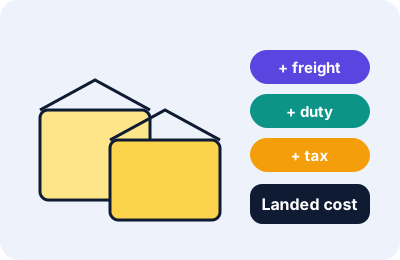
What this calculates
Landed cost is what an imported product really costs by the time it reaches you: the supplier’s price plus freight, insurance, customs duty, import taxes, clearing fees and local delivery. Dividing the total by the number of units gives the cost per unit, which you can then compare with your selling price.
How to use this tool
- Enter the number of units and the supplier’s price per unit.
- If the supplier prices in another currency, enter the exchange rate: how much of your currency equals one unit of theirs. Leave it blank if both are the same currency.
- Enter the total freight and insurance for the whole shipment, not per unit.
- Enter the duty and import tax percentages that apply to your product. Your customs authority or clearing agent can tell you.
- Add handling and local transport totals, and optionally your planned selling price.
The method used
- Goods = units × supplier price × exchange rate.
- Customs value = goods + freight + insurance.
- Duty = customs value × duty rate.
- Import tax = (customs value + duty) × tax rate.
- Landed cost = customs value + duty + import tax + handling + local transport.
Worked example
100 units at 5.00 each, freight 100, insurance 10, duty 10%, import tax 17%, handling 20, transport 30. Goods 500; customs value 610; duty 61; tax on 671 is 114.07; the total is 835.07, which is 8.35 per unit. At a selling price of 12.00 that leaves 3.65 per unit, a 30.41% margin before selling costs.
Limits you must know
- Countries calculate duty on different bases, and duty rates depend on the product’s tariff code. This tool uses the common freight-and-insurance-inclusive method and the rates you type in. Your actual customs bill may differ.
- Some businesses can reclaim import tax. If you can, enter 0 for import tax to see your cost after recovery.
- Bank charges, storage, rejected goods and exchange-rate movements between order and payment are not included.
- This is a planning estimate and not a customs declaration.
Troubleshooting
| What you see | Likely reason | What to try |
|---|---|---|
| “Enter the number of units and the price” | Units or price is empty | Fill in both |
| Result looks too low | Per-shipment costs were entered per unit | Enter freight and insurance as totals |
| Customs bill is higher | Another tariff basis or rate applies | Ask your clearing agent for the exact rates |
Notice
This is a general-purpose calculator for information only. It is not financial, tax, accounting, customs or legal advice. Rates, fees and rules differ between sellers, platforms, carriers and countries, and the figure on a real invoice or carrier quote is what counts.
Practical scenarios
- No customs duty. With the example numbers but a duty rate of 0%, the total falls from 835.07 to 763.70, or 7.64 per unit.
- Recoverable import tax. If your business can reclaim the import tax, enter 0 for the tax rate. The example then comes to 721.00, or 7.21 per unit, which is the cost after recovery.
- Comparing suppliers. A cheaper supplier with high freight and duty can cost more per unit than a dearer one nearby. Run the numbers for each and compare the landed cost per unit.
Using the exchange rate
Enter how much of your currency equals one unit of the supplier’s currency on the day you will pay. If rates move between the order and the payment, your real cost changes, so consider adding a small margin of safety to the rate.
Questions for your supplier and clearing agent
- Is the quoted price ex-works, free on board or delivered?
- What tariff code applies, and what duty rate does it carry?
- What clearing, port, storage and inland transport charges should I expect?
- Are there licence or inspection fees for this product?
Once you know your landed cost per unit, test your selling price in the Marketplace Fee and Net Profit Calculator.
Costs importers often forget
- Bank transfer and currency conversion charges.
- Port, storage and demurrage fees when clearance is delayed.
- Inspection and testing costs.
- Damaged or short-shipped goods.
- Exchange-rate movement between the order date and the payment date.
Add any of these that apply to the handling total so the per-unit cost is realistic.
Frequently asked questions
What is landed cost?
The total cost of getting a product to you, not just the supplier’s price.
Which duty rate should I use?
The rate for your product in your country. Ask customs or your clearing agent.
Can I enter freight per unit?
Multiply by the number of units first, because the tool expects the shipment total.